Buying guide
How a toy actually feels: rumble, softness, weight and temperature
Two toys with identical specs can feel nothing alike. A UK guide to rumble versus buzz, soft vibrators, shore hardness, weight, temperature and surface finish —
Published 4 September 2026 · 11 min read · Reviewed by the UK SEX TOYS product team
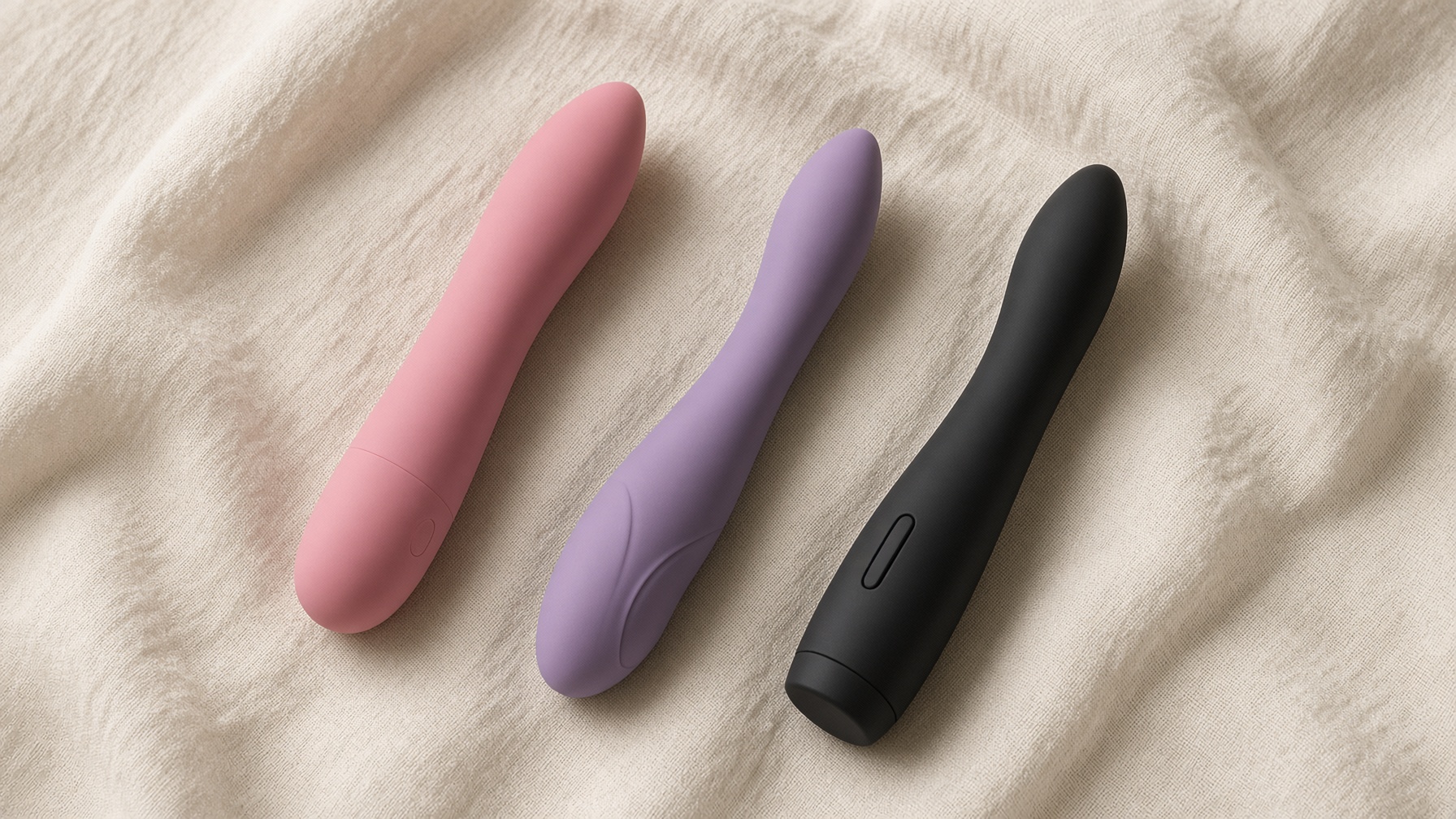
Two vibrators can share a spec sheet — same material, same length, same ten modes, same price — and feel like completely different products. People discover this after buying the second one.
Spec sheets describe what a toy is. Almost nothing on them describes what it feels like. This guide covers the five variables that actually determine sensation, none of which appear as a number on a box, and how to infer each one before you buy.
1. Rumble versus buzz
This is the single largest difference between two vibrators, and it is the one least likely to be printed anywhere.
Vibration has a frequency and an amplitude. Frequency is how fast the motor oscillates. Amplitude is how far it travels in each oscillation. Most marketing collapses both into "power", which is why "20 modes" and "extra powerful" tell you nothing useful.
Buzzy means high frequency, low amplitude. Fast, fine, surface-level vibration. It reads as intense immediately, stays close to the skin, and tends to cause numbness faster because the same nerve endings are being stimulated at a rapid, unvarying rate.
Rumbly means low frequency, high amplitude. Slower, deeper, more of a thud than a tickle. It travels further into tissue, so it reaches structures below the surface, and most people can use it for longer before sensation dulls.
Neither is better. Buzzy suits precise, external, short-session use. Rumbly suits broader contact, internal use and longer sessions. But the majority of people who report that a toy was "too intense and then I stopped feeling anything" have bought a buzzy toy and would have preferred a rumbly one.
How to tell before buying. Manufacturers rarely state it, so use proxies. Larger motors produce more rumble, so wand-style and larger-bodied toys skew rumbly, while slim bullets skew buzzy. Product copy that emphasises "deep" or "rumbling" is usually accurate, because it is a specific claim rather than a generic one — the Orchard Tempo listing leads with "deep, rumbling power kept whisper-quiet", which is a meaningful description. Copy that only says "powerful" tells you nothing. And a toy that is audibly high-pitched in a video is buzzy; a lower-pitched hum is rumbly. Sound frequency and vibration frequency are the same thing.
2. Softness, and what it actually buys you
"Soft vibrator" is one of the more common things people search for, and it is a sensible thing to want.
Silicone hardness is measured on the Shore scale. Soft, squashy silicone sits at the low end; firm silicone that holds a rigid line sits considerably higher. Manufacturers almost never publish the figure, so again you are reading proxies — but the difference in use is large.
Soft silicone compresses on contact and conforms to the body. It makes a given diameter easier to accommodate, because it deforms on entry and re-expands once past the tightest point. It is more comfortable for pressure held over time. Its cost is transmission: soft material absorbs vibration, so a soft-bodied vibrator delivers less of its motor's output to you than a firm one with the same motor.
Firm silicone transmits vibration efficiently and holds its shape against muscle pressure. That precision is what you want for anything targeting a specific spot. Its cost is that it is less forgiving of a bad angle.
Dual-density construction — a firm core under a soft outer layer — is how better products get both, and it is worth paying for when it is on offer. It feels soft to the touch and still transmits.
The Soft Aura Silicone Clitoral Vibrator is a straightforward example of the soft end being the right choice: it is soft silicone, 15mm insertable, waterproof, quiet, and explicitly positioned for people starting out. Softness there is doing exactly what softness is good at — lowering the barrier to comfortable use.
How to tell before buying. Look at the photographs. A toy shown bending, drooping or flexing is soft. A toy photographed holding a perfectly straight line is firm. "Ultra-soft", "velvety" and "squishy" in copy are reliable; "premium silicone" is not a firmness claim at all.
3. Weight
Mass registers as pressure, and pressure registers as size. This is the most underrated variable in the catalogue and the cheapest way to make a familiar size feel new.
A metal plug at 30mm can feel more present than a silicone one at 38mm, purely because of weight. Our anal department includes anodised aluminium alongside 58 silicone products, and people who try metal after only using silicone consistently describe it as feeling larger than the measurement suggests.
Weight also changes over time in a way nothing else does. A heavy toy that is excellent for twenty minutes is a different object at ninety. If you are choosing something to wear rather than to hold, weight is the variable to be conservative about.
Glass sits in between. Borosilicate is heavier than it looks and much lighter than steel.
4. Temperature
Silicone is a thermal insulator. It arrives at room temperature, warms slowly to body temperature, and then stays there. It has essentially one temperature: yours.
Glass and metal are conductors. They take on whatever temperature you give them and hold it for several minutes. This is a genuine second dimension of sensation available on products you may already own, and it costs nothing.
The method is dull and that is the point: run the toy under warm running water for a minute, or cool water for a minute. Dry it. Test it against the inside of your wrist — the same test used for a baby's bottle, for the same reason. Then use it.
What not to do: no microwave, no freezer, no boiling water immediately before use, no ice cubes held against the surface. Glass and metal hold temperature well, which is exactly why an unsafe starting temperature stays unsafe. Mucous membranes burn at temperatures that skin tolerates.
This is also where the copper question comes in, since "copper sex toy" is something people search for. Copper is a colour name in our catalogue, not a material, and there is a good reason nobody makes intimate products from actual copper: it oxidises on contact with moisture and forms surface compounds that transfer to skin. Inert metals — anodised aluminium, surgical stainless steel — give you the same weight and thermal behaviour without the reactivity. The full explanation, including why "copper moulds" is a casting-kit search rather than a toy search, is in The Copper range — and no, it isn't made of copper.
5. Surface finish
The last variable, and the one people notice without being able to name.
Matte silicone has drag. It grips slightly against skin, which feels controlled and secure, and it needs more lubricant than you expect because the surface resists sliding. It also attracts lint aggressively — store it in a bag, not a drawer.
Polished glass and metal are slick. They glide with very little lubricant and feel frictionless. Some people find this the single best argument for glass; others find it too slippery to control.
Textured surfaces — ribs, ridges, beads — produce sensation through change rather than constant contact. They register most on movement and barely at all when held still. If you like a sensation that varies as you move, texture delivers it; if you want steady pressure, texture mostly gets in the way.
Surface interacts with lubricant more than any other variable. Matte silicone with too little lubricant is uncomfortable; polished glass with too much is uncontrollable. The rule that overrides everything else: silicone-based lubricant degrades silicone toys. Water-based is the safe default across every material we stock. That is covered properly in Which lubricant, and why it matters more than the toy.
Air pulse is not vibration
Worth separating out, because it is a genuinely different mechanism and people searching for "sex aer" or "air" toys are usually looking for this.
Suction toys do not create suction in the vacuum-cleaner sense. They generate rapid pressure waves in a sealed chamber held against the body. Nothing is being pulled; pressure is oscillating.
The practical consequence is that it feels nothing like vibration. Vibration stimulates a broad area through direct contact. Air pulse stimulates through pressure change, without the surface contact that causes numbness — which is why people who go numb quickly with vibrators often get on well with air pulse.
It also means the seal matters more than the intensity setting. A pressure-wave device that is not sealed against the body does nothing at all, regardless of setting. If a suction toy feels weak, the answer is almost always positioning rather than power. The Lotus Crown is an example of a product combining both mechanisms — internal vibration with external air pulse — which is a different proposition from a rabbit with two motors.
The mechanism is explained in full in Suction toys don't actually suck.
Noise, honestly
Noise is a feel variable, because a toy you are self-conscious about is a toy you tense up with.
Motor noise rises with power and falls with build quality. Thin, hollow-bodied toys act as resonators and amplify their own motors. Denser, thicker-walled toys damp them. Soft silicone absorbs sound as well as vibration, which is one of the compensations for its lower transmission.
The practical points: airborne noise is rarely the problem in a flat — structure-borne noise is. A toy on a mattress transmits into the bed frame and through the floor. A folded towel underneath does more than any spec on the box. Water running or music playing masks the frequency range most motors sit in.
We keep a Quiet by design collection for exactly this, and there is more in Quiet toys, thin walls.
Reading a spec sheet for feel
Every listing on this site carries structured fields: material, insertable length, water resistance, power source, control type, flared base, beginner suitability. Here is what each one implies about sensation.
Material → temperature behaviour and weight. Silicone is warm and light. Glass and metal are conductive and heavy.
Insertable length → less than you think. Reach matters far less than angle for anything targeting a specific spot. Our prostate massagers start at 35mm insertable and that is genuinely sufficient.
Power source → a rough proxy for motor size. USB-rechargeable products generally house larger motors than button-cell battery products, and larger motors generally rumble.
Beginner friendly → on our listings this is a real flag, not marketing. Orchard Tempo is not flagged beginner friendly despite being a popular mid-price product, because three simultaneous motors is a lot of input for a first rabbit.
Water resistance → cleaning options as much as bath use. Fully submersible products can be cleaned much more thoroughly.
What is missing from every spec sheet, ours included: frequency, amplitude, shore hardness and decibels. Until those are standard, the proxies above are what you have.
Matching feel to purpose
- Goes numb quickly → rumbly, or air pulse. Avoid slim buzzy bullets.
- Wants to size up comfortably → soft silicone, gradual taper.
- Wants precision on a specific spot → firm silicone or glass, curved.
- Wants a familiar size to feel new → change material. Metal or glass at a size you already own.
- Shares walls → larger dense body, soft silicone, a towel under the mattress.
- Wants variety without buying more → temperature play on a glass or metal toy you already have.
Reviewed by the UK SEX TOYS product team.
Keep reading
- Materials, and what body-safe actually means — 6 min
- Suction toys don't actually suck — 5 min
- Choosing your first vibrator — 6 min
- Quiet toys, thin walls — 4 min
Ready to shop? Browse vibrators or try the four-question finder.
Frequently asked
- What is a soft vibrator, and is it less powerful?
- Soft means low shore hardness — the silicone compresses under pressure. It is more comfortable and easier to accommodate, but soft material absorbs vibration, so it transmits less of the motor's output than a firm body would. Dual-density construction is the way around that.
- What is the difference between rumbly and buzzy?
- Rumbly is low-frequency, high-amplitude vibration that travels deeper into tissue. Buzzy is high-frequency, low-amplitude vibration that stays at the surface and causes numbness faster. Larger motors tend to rumble; small bullets tend to buzz.
- Are copper sex toys safe?
- Real copper is a poor choice for intimate use because it oxidises on contact with moisture and forms compounds that transfer to skin. Products named Copper in our catalogue are silicone in a copper colourway, not copper metal. For weight and temperature, anodised aluminium or surgical stainless steel are the inert options.
- How do I warm up a glass or metal toy safely?
- Warm running water for about a minute, dry, then test against the inside of your wrist before use. Never a microwave, freezer or boiling water — conductive materials hold temperature, so an unsafe starting point stays unsafe.
- Why does my suction toy feel weak?
- Almost always the seal rather than the power. Air-pulse devices work by oscillating pressure in a sealed chamber; without a seal against the body, no setting will feel like much.
Keep reading
Ready to shop against this? Try the four-question finder.